


- HOME
- SPECIES
Featured
Higher dietary nutrient contributionsWe have developed an enzyme application strategy called Maximum Matrix Nutrition, which capitalises on the properties of Quantum Blue, an enhanced E. coli phytase with a high affinity for phytate, in addition to a thermostable and inhibitor-resistant xylanase, Econase XT.
Improved monitoring of raw materials and finished feedsOur range of NIR Services aims to provide a convenient and cost-effective ability to analyse feeds and raw materials, using calibrations, process control, support and analytical tools.
Stimulating the microbiome to improve productivityIncreasing understanding of fibre is presenting a new perspective on the valuable role it can play in gut health and therefore, within performance-enhancing nutritional strategies.
EXPERTS IN ANIMAL NUTRITION FOR THE ANIMAL FEED INDUSTRY
- PRODUCTS
All Products
Quantum Blue works to unlock all six phosphorus molecules, releasing inositol and valuable nutrients that would otherwise stay bound to phytate.
INDUSTRY-LEADING PRODUCTS TO MAXIMISE ROI
- SERVICES
- INSIGHTS

















Poultry gut health: stimbiotics, caecal sampling and data collection
Published Thursday, 25th June 2026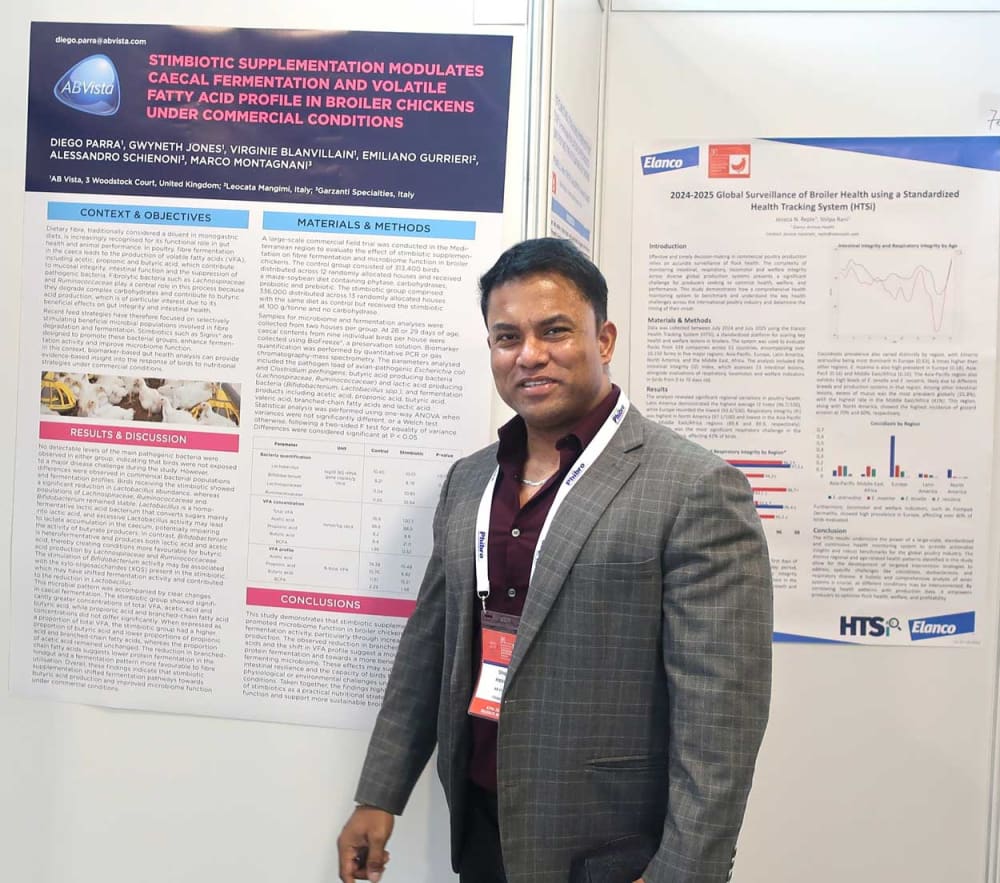
Together, this work contributes to a clearer, more practical understanding of gut health under commercial conditions. In this blog, we explore these topics in more detail.
1. Stimbiotic supplementation and fibre fermentation in broilers
A study led by Diego Parra (Technical Business Manager), alongside Gwyneth Jones (Technical Services Manager), Dr Virginie Blanvillain (Global Services Manager), Emiliano Gurrieri, Alessandro Schienoni and Marco Montagnani (Leocata Mangimi and Garzanti Specialties), has explored the role of dietary fibre in broiler gut health under commercial conditions.
Dietary fibre, traditionally considered a diluent in monogastric diets, is increasingly recognised for its functional role in gut health and animal performance. In poultry, fibre fermentation in the caeca leads to the production of volatile fatty acids (VFA), including acetic, propionic and butyric acid, which contribute to mucosal integrity, intestinal function and the suppression of pathogenic bacteria.
Fibrolytic bacteria (such as Lachnospiraceae and Ruminococcaceae) play a central role in this process because they degrade complex carbohydrates and contribute to butyric acid production, which is of particular interest due to its beneficial effects on gut integrity and intestinal health.
Recent feed strategies have, therefore, focused on stimulating microbial populations involved in fibre degradation and fermentation. Stimbiotics (Signis®) are designed to enhance fermentation activity and improve microbiome function. In this context, biomarker-based gut health analysis can provide evidence-based insight into the response of birds to nutritional strategies under commercial conditions.
Stimbiotic field trial & gut function
A large-scale field trial in the Mediterranean evaluated stimbiotic supplementation in broilers. The control group (313,400 birds across 12 houses) received a standard maize–soy diet with enzymes, probiotic and prebiotic, while the stimbiotic group (336,000 birds across 13 houses) received the same diet with stimbiotic (100 g/tonne) but no carbohydrase.
Samples for microbiome and fermentation analyses were collected from two houses per group at 28-29 days. No major pathogen levels were detected, indicating low disease pressure. However, stimbiotic supplementation altered microbial balance and fermentation patterns.
- Lactobacillus abundance decreased
- Beneficial groups such as Bifidobacterium, Lachnospiraceae and Ruminococcaceae remained stable
- Together, this supported a shift toward more efficient fibre fermentation
Field trial results: The study showed that Signis supplementation enhanced microbiome function by increasing fermentation activity, particularly butyric acid production. Reduced branched-chain fatty acids and shifts in VFA profiles indicate less protein fermentation and a more beneficial fibre-driven microbiome. These changes may support gut health, resilience and performance under commercial conditions, highlighting stimbiotics as a practical strategy for improving gut function and sustainability in broiler production.
2. Compositional and multivariate approaches to caecal sampling
Research by Zack Ng (Senior Scientist) and Dr Virginie Blanvillain examined whether caecal drop can provide a biologically meaningful, non-invasive alternative to caecal content for VFA analysis.
VFAs are key functional markers of gut microbiome activity and intestinal health. Caecal content is considered the reference matrix for analysis, but its collection requires culling and limits longitudinal monitoring. While faecal samples are non-invasive, they do not reliably represent caecal fermentation due to post-caecal modification. Caecal drop, originating directly from the caeca, offers a potential alternative, although its comparability to caecal content requires validation.
Paired caecal drop and caecal content samples were collected from 28-day-old broilers and analysed for VFA using gas chromatography-mass spectrometry. A multi-layered statistical framework was applied to assess compositional similarity and quantitative agreement, including centred log-ratio paired tests, principal component analysis, Aitchison distances, Bland-Altman analysis and Lin’s concordance correlation coefficient.
The analysis demonstrated that caecal drop does not achieve sufficient agreement with caecal content to be used interchangeably for individual-level quantitative assessment. Bias was observed for branched-chain fatty acids and valerate, while propionate and butyrate showed wide limits of agreement.
However, caecal drop was shown to capture the overall fermentation profile of caecal content, representing a biologically meaningful indicator of microbial activity. This supports its use for group-level comparisons, longitudinal monitoring and welfare-conscious research, while caecal content remains the reference for absolute measurements.
3. From measurement to meaning in gut health data
In related work, Claire Davis (R&D Research Scientist), Zack Ng and Dr Virginie Blanvillain addressed the interpretation of complex gut health datasets generated under commercial conditions.
As data collection capabilities expand, interpretation becomes increasingly challenging due to multiple biomarkers, hierarchical structure and inherent variability. The study highlighted several key considerations.
- The experimental unit must be clearly defined, with performance data typically analysed at pen level, while microbiome and VFA data are measured at bird level within shared environments. This raises questions around independence, as birds within the same system are not fully independent due to shared feed, management and environmental conditions.
- The importance of true replication and appropriate randomisation was emphasised, alongside the need to account for background variation. VFA data often show non-normal distribution and heterogeneous variance, and limited sample sizes in commercial trials can restrict transformation and filtering.
- Individual variation should therefore be considered as biologically meaningful rather than treated as noise. Interpretation should focus not only on mean values, but also on distribution, variability and underlying biological mechanisms.
Overall, the framework encourages robust experimental design and data-driven analytical approaches to ensure that complex datasets are translated into meaningful and reliable conclusions.
Key takeaways
Stepping back from the detail, this work reflects a broader shift in how gut health is being approached, with growing emphasis on nutritional strategies that actively shape fermentation pathways, alongside the development of more practical and welfare-conscious sampling methods.
At the same time, there is increasing recognition that data generation is only part of the challenge, and that careful interpretation is also essential to unlocking its true value.
Together, these insights highlight a more connected approach to gut health research, one that links nutrition, measurement and analysis more closely to the realities of commercial poultry production.
Latest news
Stay ahead with the latest news, ideas and events.

Online Feed Fibre Calculator
Calculate the percentage of dietary fibre in your feed
Our calculator is designed for nutritionists and uses averages of global raw materials to calculate the dietary fibre content (plus other more in-depth fibre parameters) of finished animal feed. These parameters are available within AB Vista’s Dietary Fibre analysis service (part of our NIR service).
Sign up for AB Vista news
A regular summary of our key stories sent straight to your inbox.
SUBSCRIBE
Woodstock Court, Blenheim Road, Business Park, Marlborough, Wiltshire, SN8 4AN
© AB Vista. All rights reserved 2025
Website T&Cs Privacy & Cookie Policy Terms & Conditions of Sale University IDC policy Speak Up Policy